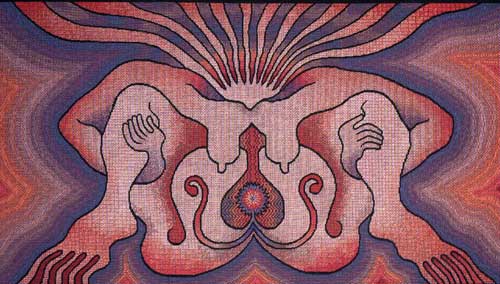
My little sister is a big fan of Def Jam Poetry. Earlier this week she posted a poem on her blogthat literally took my breath away. It was as if the poet had looked into my mind and translated onto the page everything I think, feel, fear about being a mother.
Sunday, May 09, 2010
Wednesday, September 09, 2009
The Truth About Pop Music and Feminism
This past Saturday, mr. mraynes and I watched High Fidelity for the first time. About fifteen minutes into the movie, the John Cusack character asks, "Did I listen to pop music because I was miserable, or was I miserable because I listened to pop music?" This question resonated with me because I have recently been asking myself a similar question:
Am I feminist because I'm discontented, or am I discontented because I'm a feminist?
Since leaving my job, moving to a new state and becoming a stay-at-home mother, I have felt a level of unhappiness that truly surprised me. I expected the transition to be hard but I did not expect to feel so vulnerable all of the time. My self-esteem completely collapsed in the space of two weeks and I am left feeling overwhelmingly helpless. Things are starting to get better, I am settling into a routine and I'm sure that with time, I will even enjoy being at home. But that doesn't negate the very real fact that changing my fairly progressive lifestyle to a traditional one has wreaked havoc on my emotions, my relationships and my general happiness with life.
My question above is a proverbial chicken and egg question and really one of assigning blame; whose fault is it for my disillusionment with domesticity? The answer may seem obvious but humor me for a minute. Let's analyze the first part of my question, am I feminist because I'm discontented? This begs the question, what in my life makes me discontented enough to turn to feminism? Well, the lack of quantifiable equality within the church and its' rhetoric on gender causes me a great deal of pain and frustration. The invisibility of women in scripture, doctrine and bureaucracy is problematic at best. The diminishing of women to certain roles by Mormon culture echoes the objectification of women found in our broader society. We, as Mormons and members of society, should do better. This is why I am a feminist, to document, analyze and hopefully make better the small circles in which I travel.
If we are getting more specific to my life, I hate the inequitable division of domestic labor that mr. mraynes and I have now. Yes, he comes home and does the dishes but it doesn't equal the multiple times I am on my hands and knees picking up cheerios each day. I hate feeling dependent on my husband to cover my basic needs. If I was to look at our relationship through the lens of academic feminism, the power dynamic in our relationship has changed dramatically. Money is power; before we were both financially contributing to our family, now I rely on the good will of mr. mraynes to see his money as "our money." My knowledge of feminist theory is what I use to empower myself, it is my safety net in case I ever have to remind mr. mraynes not to be a misogynistic jerk. (I should note that this whole paragraph is horribly unfair to mr. mraynes who, himself, has been the stay-at-home dad and who has been nothing but kind, supportive and an egalitarian angel throughout this transition and our whole marriage.)
This brings me to the second half of my question, am I discontented because I'm a feminist? This is a hard question for me to want to answer honestly. Certainly if I didn't have the framework of Friedan, Steinem, de Beauvoir, Toscano, it would be harder for me to articulate the gender inequities that I saw in the church, society or my individual life. I guess the question is, would I see them at all if I wasn't a feminist? I can't answer this question because I have never not been a feminist. I grew up in an egalitarian home and, although my feminism grew from that point, my expectation from life has always been equality. But in my dark moments (like the one that caused me to vow never to set foot in the Denver Public Library again), I really have to wonder, would I be happier if I always had the expectation of a traditional lifestyle and wanted nothing else? The "grass is always greener" side of me says yes, after all, Seriously So Blessed isn't parodying nothing.
Does feminism make women happy is another proverbial question, one that has had lots of heated discussion already bestowed upon it. (See here, hereand here for a few examples). This is the conclusion I've come to: if feminism makes people unhappy it is because it illuminates all of the nasty parts of reality. It is much nicer to pretend inequality doesn't exist or to not care if it does because it doesn't affect you. I understand that this is a personal decision for every woman and man to make and I don't judge anybody for not wanting to live a life where they see sexism, oppression and abuse all around them. But the truth is, these things do exist and some of us are going to see and speak it even if it is inconvenient or uncomfortable.
In the end, attempts to place blame, whether it be on feminism, the church or leprechauns, are always red herrings. Truth is complex and often it is easier to blame an other than to be comfortable with that complexity. I am currently trying to accept my own truth; yes, I am discontent because I'm a feminist, but also because reality sucks and I am pre-disposed to be melancholy. But I gain nothing by blaming anybody or anything for my unhappiness; all I can do is work hard to find some measure of joy in the place that I am.
Wednesday, September 02, 2009
Alright, it's time
Tuesday, March 17, 2009
Weekly Anti-Woman Wacko[s]: St. Patrick's Day Edition
The answer to all our problems is staring us in the face...Does the womanPretty funny, huh? No? Well it was supposed to be. Apparently this was a satire piece taking aim at the chauvinist media. The problem was that nobody got it.
in your life really need a job?...
Of course there will always be a place in the world of business for
exceptional women. Women also have an important role to play in jobs that
are too demeaning for men, like teaching. But the general employment
of women is another matter. Indeed, working women almost certainly caused
the credit crunch by bringing a second income into the average household,
pushing property prices up to unsustainable levels...
It would be ludicrous to suggest that women should be sacked purely to give
men their jobs...In many cases, their jobs should be abolished as well...
While the economic case for fewer women in the workforce is irrefutable, we
should also acknowledge the social advantages. Women make the majority of
spending decisions in Irish households and make almost all of the
purchases. They are far more likely than men to regard shopping as a
leisure activity...In short, women were the driving force behind the greed,
consumerism and materialism...and it was female employment that funded their oestrogen-crazed acquisitiveness.
The article quickly went viral and set off a firestorm. There was an account of this article being forwarded three hundred times in the space of a couple of hours around one large company that employed most men. Reportedly, these men viewed the article in a positive light.
As you might expect, women were none to happy about this op-ed. Hundreds of women sent in angry letters to the editor only to receive a curt letter back informing them that the piece was satire, along with a suggestion that they develop a sense of humor.
After reading through Newton Emerson's essay several times, I can see that it is satire, it is bad satire but, satire nonetheless. However, the reason people didn't get it was because there was no clear target, the piece was just too broad. Satire is not funny if it is overly believable. I picked this piece as an illustration of a weekly wacko because there is no cognitive dissonance in believing that a person could hold this kind of opinion.
Women have historically been blamed for the downfalls of society. We can start with Mother Eve and wind our way through the annals of history to today where working women are blamed for everything from increased juvenile delinquency to childhood obesity. (I heard that one over the pulpit).
So yes, I can understand how this unfunny piece of satire was misunderstood; it hit too close to home to the bullsh*t that working women have to put up with everyday. Is it not enough that working women have to face their own guilt every morning they walk out the door, do we really have to blame them for all of societies ills?
Shame on Mr. Emerson for being a horrible satirist. Shame on the Irish Times for exploiting pervasive and pernicious sexism. And shame on any man or woman who truly thinks that all of society's problems will be solved the moment we kick women out of the workforce. You are all my weekly wackos.
Tuesday, March 03, 2009
Mistress of History
I once had a boyfriend who told me that women have no history outside of their husbands and children. I was a young history major at the time and was only just discovering where my interests lay but his ignorant remark sparked in me a profound desire to prove him wrong. Needless to say, our relationship did not last much longer but I was left with a new found feminism and a love of women’s history.
Over the next couple of years I would study the lives of Hildegard Von Bingen, Martha Ballard, Alice Paul, Betty Friedan…all women who left a mark on history outside the framework of domesticity. Also around this time I received a copy of my grandfather’s memoir which included his version of the end of my grandparents’ marriage. As I read through this story of my grandfather’s life, I wondered how different my grandmother’s version of their divorce would be. She probably would not have painted herself in the light my grandfather had. Unfortunately, her story is lost to history and what remains of her life is only in the memories of her sons and ex-husband.
By the time I graduated from college, I knew the importance of women’s stories but I also understood that historically, women have had to go to greater lengths to get those stories heard. As an idealistic young feminist, I was determined to create my own history; husband and children might come but I would not allow them to define my life, let alone allow myself to be lost in their history.
What I did not understand as an idealistic young feminist was how easy it is for any woman, feminist or not, to fall into this trap. I fully admit that I have lost some of my resolve. None of us can write our history in advance and so as my life has failed to follow the course I imagined, it has become easy to define myself in terms of my husband and children. It is so easy to proudly talk about my husband, the orchestral conductor who is so smart and so talented.
It is a delight to revel in my beautiful Monster who dances and laughs in and out of my presence or Baby Valkyrie who thrives on my love and brightens my life with her smile. I have re-defined myself in the terms of my family because it is the one thing that I feel truly good at, that I am proud of. Yes, I have a life and a career outside of my home but those things are not as fulfilling as I imagined them to be.
I feel at times that my life is at a standstill, waiting for my husband to finish school and get a job, or for my babies to grow up a little or for me to go back and get my graduate degrees. Often I feel like I am just waiting for my real life to begin. I suppose that we all need times of limbo to help focus ourselves, to make the way forward more clear. But how sad if I allow myself to get stuck here.
And so in honor of Women’s History Month, and in honor of my fore mothers, I resolve once again to make my own history. But this time I make my resolution with a little less naivete, with the understanding that my husband and children are part of my history. Part of my history because I have given so much of myself to them and in return they have given themselves to me. And with this gift I realize that it is up to me to be the mistress of my own history.
Wednesday, January 07, 2009
The Woman Without a Shadow
mr. mraynes and I are opera geeks. I spent the first years of my college career training to be an opera singer; mr. mraynes has spent the majority of his doctoral program immersed in opera scores, learning how to conduct them. Where a lot of couples have a song taken from pop culture, our song was “Liebestod” from Tristan und Isolde. Every major moment in our relationship is connected to an aria or opera. Dating…Cosi Fan Tutte. Falling in love… “Liebestod” . Engagement…Turandot. Marriage… “Morgen” . Birth of Baby Monster… “Song to the Moon” . Birth of Baby Valkyrie…Brunhilde’s Immolation. (Sorry, I couldn’t resist sharing these moments with you.)
And so it should not have surprised me that the first thing mr. mraynes said to me after getting an IUD was, “Ahh, die frau ohne schatten,” meaning ”the woman without a shadow.” Now for those not familiar with the Strauss opera, Die Frau Ohne Schatten is a fairytale of love blessed through the birth of a child. As lovely as this sounds and despite the absolutely breathtaking music, this opera is a feminist’s nightmare. You see, a woman without a shadow is a woman who can’t have children…making her not a real woman and therefore, not human. Throw in a little domestic violence and the belief that women are chattel and you have three hours of anti-woman fun.
At the beginning of the opera we learn that the Emperor of the Southeastern Islands will be turned to stone unless is wife, the daughter of the King of spirits, becomes human and gains a shadow. Of course, it is hard to feel sorry for the Emperor when we learn that he captured the Empress and believes that she is “for my soul and for my eyes and for my hands and for my heart. She is the booty of all booty without end.” Despite being captured and married against her will, the Empress goes in search of a shadow so her husband won’t be petrified. The Empress and her nurse meet a human woman who resents her life as a domestic slave to her husband and doesn’t want to be a mother because she fears children will further enslave her. Long story short, the nurse convinces the woman to sell her shadow to the Empress. When the woman’s husband finds out, he threatens to kill her because without her shadow, without the ability to bear children, she is useless to him. Luckily for the wife, the Empress refuses the shadow, saying she will not save her husband at the expense of another man’s happiness. This act of self-sacrifice allows the Empress to gain her own shadow. The opera ends with the two couples united and fertile, singing the praises of their humanity.
As a feminist, there is so much in this opera that I find objectionable. I resent the belief that my only value as a woman lies in my ability to bear children. This belief can be found around the world in almost every culture. Historically, women have not been allowed to become fully actualized individuals, not allowed to explore the things that would bring them the most happiness. Instead women are forced into a lifestyle they wouldn’t necessarily choose. For women who can’t have children, there is the feeling of failure on top of the overwhelming sorrow that comes along with infertility. Women who are childless, whether by choice or not, are often seen as dangerous and are at increased risk for emotional and physical violence.
Of course, the pendulum can swing too far the other way as well. In cultures where maternity is glorified, female subordination often goes hand in hand. The idea of the angel in the home, while romantic, only serves to infantilize women and take away their ability to be agents unto themselves. A doll’s house existence is no existence.
Second wave feminists worked hard to give women like me the choice to become mothers and also follow our dreams of self-fulfillment. But socialization dies hard. When mr. mraynesreferred to my shadowless status, I felt guilty. I cried while the IUD was being implanted. Even now, when I think about that small piece of plastic floating around in my uterus I have to fight off the urge to reach inside and yank it out. I admit that I have felt like less of a woman knowing that my fertility is compromised. Intellectually I know this is ridiculous and I am ashamed of myself. I have no right to feel this way. I have two babies and though I have chosen to see them as the crowning achievement of my life, I don’t want my choice perverted by some outdated notion that my worth lies exclusively in the fruitfulness of my womb. Getting an IUD was absolutely the right thing to do; it was right for my marriage, for my children, for our current financial and life situation and for my own state of mind.
And yet…I am haunted by my shadow.
Monday, December 22, 2008
Family Blog
http://www.sinfoniadomestica.blogspot.com/
Sunday, November 02, 2008
The Grand Tapestry
A wise woman once said that “vision is the ability to realize that the truth is always larger than the partial present.” It is easy to become enmeshed in the partial present, to be so concerned with our daily existence, that we forget that our lives serve a greater purpose and is part of a grander whole. Indeed, it is hubris to believe that we live our lives purely for our own sake, for we are all interconnected in the great plan of God. This plan connects us with every other spirit and intelligence in the universe. It connects us with God and makes the atonement of Jesus Christ operational on our behalf.
The plan of salvation is like a grand tapestry. Each of us is a small thread in this tapestry; intersecting, connecting, separating and intersecting again. Moving from color to color, dark to light. We may not know what contribution our small thread makes to the great tapestry. We may not understand the pattern that our lives make, but God does. It is God’s plan that incorporates and connects us all. It is that plan that will bring us eternal happiness.
As Moses 1:39 tells us, God’s purpose is to bring to pass the immortality and eternal life of man. No matter the time period and regardless of the culture into which a spirit is born, every life is infinitely precious because God’s purpose extends to every individual. In the pre-mortal existence, our intelligences were organized into individual spirits and we became the children of our Heavenly Father and Heavenly Mother. In our primeval childhood, we were nurtured by the side of God. We grew and developed and desired to progress further. We desired the opportunity to discern good from evil; to prove to our Heavenly Parents our ability to become like them and live as exalted beings in their presence forever.
And so, in their great love, they came up with a plan that would insure our happiness and immortality. Each spirit child would have to leave the presence of God for a time. In order to fully prove ourselves, it would be necessary to withhold the recollection of our former friends and birth. As we sojourned through mortality, we would make choices based on our discernment of good and evil. Our Heavenly Parents knew the mortal weakness each of us would suffer, and so in their mercy, they provided us with a Savior. Because he first loved us, he desired to be the propitiation for the sins we would inevitably commit. Our older brother would be the door through which, if we entered, we would be saved.
We are told that at hearing this plan, the hosts of heaven rejoiced. Two-thirds of God’s children happily chose this plan. All of us are here in mortality because we chose the plan. Everybody who has ever been born, or ever will be born, chose God’s plan of happiness. This fact should be a source of great hope and confidence to us. We all trusted God. We all loved the Savior. We were willing to take the frightening risks of mortality because we desired to be like them. We assumed the burden of freedom because we loved Christ so much. And he assumed the burden of being our Savior because he loved us so much. Before we were born, then, we had become part of a web of love, part of the grand tapestry that is the plan of salvation.
The tapestry begins with the creation of the Earth. In order for the plan to commence, a place for mortal existence had to be created. As Moses 1:4 tells us: “And the Lord said: Let us go down. And they went down at the beginning, and they, that is the Gods, organized and formed the heavens and the earth.” A great Mormon poetess beautifully captures the primordial event in her “Song of Creation”:
Who made the world, my child?
Father made the rain
silver and forever
Mother’s hand
drew riverbeds and hollowed seas,
drew riverbeds and hollowed seas
to bring the rain home
Father bridled winds, my child,
to keep the world new.
Mother clashed
fire free from stones
and breathed it strong and dancing,
and breathed it strong and dancing
the color of her hair.
He armed the thunderclouds
rolled out of heaven;
Her fingers flickered
hummingbirds
weaving the delicate white snow,
weaving the delicate white snow
a waterfall of flowers
And if you live long, my child
you’ll see snow burst
from thunderclouds
and lightning in the snow;
listen to Mother and Father laughing,
listen to Mother and Father laughing
behind the locked door.
~Linda Sillitoe
The first chapter of Moses tells us how the gods created the world; first organizing matter to create the bedrock that would form the hills everlasting. Then the gods divided darkness from light, creating the satellites of the sun, moon and stars in the heavens. The gods formed seas and fountains and then decorated the new earth with flower, fish, bush and beast. But their crowning achievement came in the creation of humankind; a man and a woman, fashioned in their own image.
Adam and Eve were the first to come to this earth, though the Garden of Eden was a transitional and paradoxical existence. They had the veil drawn over their eyes and yet, they walked and talked with god. Adam and Eve lived in a state of innocence; they could not sin, they could not die but they also could not progress. They were given two commandments; the first was not to partake of the fruit of the tree of knowledge of good and evil, the second was to multiply and replenish the earth. But they were given the gift of choice, the first gift of heaven, to choose whether or not they would keep the commandments of God. This is where the beauty of God’s plan was manifest for it is not in God’s nature to expel his children from his presence. And so he designed a plan that would allow Adam and Eve the ability to choose for themselves whether they would progress or remain in a state of innocence.
As we all know, Adam and Eve fell that men might be. Throughout the ages, our first parents have been criticized for breaking the commandment of God. But the restored knowledge of the plan of salvation has given us the vision and understanding to know that their transgression was essential to the progression of all men and women.
Though underestimated and vilified throughout history, Eve understood the greater vision of God: that man must be that they might have joy. Her statement in Moses 5:11 is perhaps the most doctrinally profound in all of scripture. “And Eve…heard all these things and was glad, saying: Were it not for our transgression we never should have had seed, and never should have known good and evil, and the joy of our redemption, and the eternal life which God giveth unto all the obedient.” Eve knew that it was the perpetuation of life, the continuation of the plan of salvation that would bring true happiness not only to herself, but to all her children. And so Eve became the first agent of light, providing the way for God’s children to receive bodies and progress to immortality.
All members of the human race must enter mortality through birth. Those of us who accepted the plan were permitted to pass through the veil that shrouds mortal life. We know women play an important role in the passage through the veil; they escort every soul through the veil, even the soul of the Savior of mankind. In a sense, they serve as the gatekeepers to our mortal world. Presiding over those who pass through the first veil, they clothe each traveler with a physical body and introduce them into mortality and agency through personal suffering and sacrifice.
This is something that I have had occasion to think a lot about recently. My own experience with the birth of my two children has been sacred and I have reflected often on the power there is in bringing life into the world. There is a point during labor where one leaves the mortal realm and is caught between life and death; it is in this sacred realm that the veil is at its thinnest. As I labored with my beloved children, I could feel a godly presence, not only sustaining me through the pain but entrusting me with the lives of two precious children, charging me to nurture them and bring them back to light.
As latter-day saints, we have been given the vision to understand that it is our families that unite and exalt us. When a man and a woman marry, they are committing to life, to love, and the perpetuation of life and love. Their mutual love for each other, unites them in a sacred cause, the perpetuation of love and life in their posterity. Both men and woman are creators of new life. Both have an obligation to nurture that life. Men help in the nurturing and loving of new life, just as women do. Parents have the responsibility to teach those to whom they give life, that there is light and love in this world, and to seek it. In this way, young souls are prepared to recognize and be receptive to the fullness of the Word of God. Women and men jointly teach their children goodness so that they might return to the presence of God.
It is, of course, up to us children to follow the light that our parents have introduced us to. Mortality is designed as part of the gospel plan to bring us mingled experiences with good and evil; that we may learn from experience to make wise choices. And many of these experiences are painful because we fail. We know ourselves to be weak. We stumble along, being less than we can be, never living up to our own standards, let alone anyone else’s. We try to obey the laws of God. The more our actions are in accordance with those laws, the more blessed and God-like we will be. If we choose, if we even desire to choose, if we even hope for the desire to choose, we set in motion the powerful forces for life that are led by Jesus Christ himself. He responds to those tender tendrils of crippled life with the force and energy that will bring them to flowering. Listen to these promises of love and yearning desire for us. Feel the hope they bring that with Him we can overcome the world. “[I] am come that they might have life, and that they might have it more abundantly. I am the good shepherd: the good shepherd giveth his life for [his] sheep.”
A true vision of the plan, one that does not see the tapestry as a single finished point, gives us the right to grow, to progress. It implies not only a God who made us, but a God who is with us, in us, and in everything around us. Whoever we are, whatever we are, this God knows us, understands us, walks with us to the melting point where what we are and what God is become one.
We are God’s children and God knows our greatest potential is to live as He does. We know why we are here. We have been given a vision of the great tapestry, the plan of salvation, through the restored gospel of Jesus Christ. We may not know what contribution our small thread makes to that tapestry. We may never know how far the effects of our service will reach. By our good works we magnify what is mighty in us all, one step at a time, one day at a time. We can never afford to be cruel or indifferent or ungenerous, because we are all connected, even if it is in a pattern that only God sees. We are all part of the pattern; black, white, brown, male or female. We are all connected in the merciful plan of our Heavenly Parents and our Savior, Jesus Christ.
May we all have the vision to know the full truth of this plan.
Wednesday, October 22, 2008
A Lullaby in the New Year
early language; for your spine to be aware
that a rocking chair means comfort and your wary
nerves want sleep. Nothing will disappear,
forsaking you to vast, fluorescent air
your fists and feet can't pummel. You shudder
at my kiss, a random bother in your hair.
I tell you this, my loud and little daughter,
you have now all there is: familiar dark,
a blanket's wings without, warm milk within,
balanced with your head in my hand's cup
in a second cradle of flesh and sound. We rock
and still you rage. I kiss your hair again.
All right, I whisper, accept, accept and sleep.
~Linda Sillitoe
Thursday, October 16, 2008
The Price I Ask
Obviously the sacrifice of the physical body is necessary when pregnant. A woman has no choice but to share food and nutrients with the growing child. Often times that foetus acts like a parasite, leeching calcium from your bones and, in my case, stealing the hormone that makes my body run normally. As that baby grows, you helplessly watch your body contort and balloon into a shape that is so unrecognizable that you cannot help but question whether it is your reflection you see in the mirror. Then, of course, there are the hormones. The hormones that make it difficult to string together a coherent sentence. The hormones that create bone-deep weariness. The hormones that make you question the intentions of every one around you, including those who love you the most.
But perhaps it is the smallest indignities that hurt the most. Like not being able to tie your shoes or the constant heartburn. Like having to say no to the piece of chocolate cake you want so badly because of the gestational diabetes that make your babies gigantic. Like not being able to get out of bed without assistance or having your back ache so badly that it brings tears to your eyes. Like being unable able to pick up your oldest child and hold him close to you. Like foregoing sex with the father of your children and the man you love more than anything because you are so big that he can't get within arm's length of you.
This doesn't even take into account what happens during birth. Nobody tells you about the doctors that treat you like a mentally challenged child. You are legs are forced back to your ears, exposing your most vulnerable parts to the cold air and the stares of anybody who passes by. Nobody talks about the blood and the shit, the fluid that comes erupting from you like Vesuvius. You don't know desperation until you have felt the crowning of your baby's head ripping apart your most delicate tissue. And then when it's all over there is the stab in the leg, the pushing, the stitching and the weeks of bleeding to look forward to. And I will do it all again.
I will do it again because the sacrifice is worth it. It is worth it to me to bring children into the world who will know what true love is. I sacrifice my body, my mind, my dignity, my free will so that a few spirits will know light and truth. It is a sacrifice I freely give to my children, my husband and my heavenly parents. It is not a sacrifice, however, that I give freely to world. The price I ask for re-populating our society with decent citizens is for the society that I willingly contribute my time, money and resources to respect the sacrifice I make.
I have a few dreams in which this respect could take form: free maternity health care, paid maternity leave, and I'm talking French style 3 year paid maternity leave, flex time, affordable daycare. But today, I'll settle on just one...Respect my life.
I took it for granted that most Americans, most politicians, even the Mormon church agreed that the life of a pregnant mother is of value and should be protected at all costs, even if that cost comes at the expense of the child she is carrying. I am hopeful that this is the case but it scares me that a man who could be elected president of the United States could on national television say that exceptions for a woman's "health", are an extreme pro-abortion position. As a childbearing woman, to have concerns about my health so openly and condescendingly sneered at, was beyond horrifying.
So to John McCain and all those who believe like him, I have this to say:
My life is of value. My health is of value. This is personal to me. I am not part of an extreme pro-abortion conspiracy to murder all the unborn children that take up residence in my womb. I am a wife and a mother. A woman who cares for society's outcasts and comforts the abused. I am a woman who has served my country bravely, just like you have, sir. I have walked through the valley of the shadow of death twice to bring children into this world. Children who will love their country and protect her freedoms. Children who will be part of the next generation of American goodness. We have both sacrificed for our country, sir and though you may not believe it, our sacrifices are equal. Just like the value of our lives are equal. I respect the sacrifice you made for this country. And now I ask the same respect from you.
Monday, October 06, 2008
A Tale of Two Births
Cross posted at Exponent II
Tuesday, August 12, 2008
What Mary Kay Women Know
I'm not sure what tipped us off first, maybe it was the "Think Pink" slogans plastered on the walls or the huge bouquets of frothy, pink tissue paper flowers that decorated the entire room but we quickly figured out that we had walked straight into a pink-colored Mary Kay trap. There was no facial or massage to look forward to, just a two hour presentation on the joys of being a Mary Kay consultant. (In the interest of full disclosure, I did have the "opportunity" to exfoliate half of my face with the dollop of microderm abrasion cream they gave me and massage some night time lotion into my hand so I guess Mary Kay played us fair.)
As I sat there listening about the wonders of pink Cadillacs and the free, over-sized gold jewelry, I couldn't help but compare the Mary Kay culture with the culture of women in the Mormon church. Of course there were the obvious comparison like the tacky floral arrangements and centerpieces, the be-ribboned favors and the smell of synthetic sugar and spice that hits you right in the face. But the deeper similarities went to the language used and the assumptions of what an ideal woman is. I swear the keynote speaker gave the Mary Kay version of President Julie Beck's "Mothers Who Know" speech. I took some notes and thought that I'd share them here.
- Mary Kay women understand how important things like food, free stuff and fun activities are.
- Mary Kay women know that appearences are important and always take time to look presentable.
- Mary Kay women understand that their priorities have always been God first, family second and career third.
- Mary Kay women know that if they have their priorities straight, they will be rewarded with beautiful homes, nice cars, expensive jewelry and good kids.
Mary Kay women understand that because they know their priorites, other women's children (read working women's children) will call them mom and other women will be jealous of the magical life Mary Kay women lead.
Before some of you get too offended and start cursing my name, I deeply respect the mission of Mary Kay to help women have a career and feel good about themselves. I believe that all women want to belong to a group and have their choices validated. I was amazed when the Mary Kay consultants talked about how they appreciated their organizations focus on helping women achieve their priorites and become their best selves. These women became emotional when talking about the wonderful women they met through their work and how they would drop everything to help a sister consultant. I hear this same sentiment expressed every week in my Relief Society, and yet there are thousands of women who hate Relief Society and find being a Mormon woman exquisitely painful.
Mary Kay and the Relief Society are not that fundamentally different; both organizations exist to create a space for women in male-dominated institutions. So why is it that one group has a much higher satisfaction rate than the other? I believe the difference lies in choices. If I choose to be a Mary Kay consultant, I am choosing the culture of Mary Kay. If I don't like pink cadillacs, flashy jewelry and talking about make-up then I can choose a different career. Mary Kay women know that their choices will be supported because they have surrounded themselves with women who have made similar choices.
The same is not necessarily true for Mormon women; I may choose to be a faithful member of the church but I may not want to choose the culture of the Mormon church. I may not want to hear the overblown rhetoric about motherhood but if I want to go to my church meetings and interact with my fellow latter-day saints, then there is really no escaping it. This can be an incredibly isolating place for a woman to be and it behooves us as sisters and Christians to be sympathetic of that.
The controversy over President Beck's "Mothers Who Know" talk is the perfect example of this. Many women, both liberal and conservative, were hurt by this talk, not because they necessarily disagreed with Julie Beck's actual words but were pained by the implication of what those words meant to them. The latest "firestorm" at the Sunstone Symposium only proves further how deep the wounds are and how many have been wounded. The uproar that has ensued over the past ten months has left many scratching their heads and wondering why this talk? How is it any different from what has been said over the past thirty years?
Might I suggest that it is because the rhetoric of ideal womanhood and motherhood is no longer effective in a worldwide and rapidly progressing church. From what I understand, women outside of the United States don't get what all the fuss is about because they found the talk benign at best, irrelevant at worst. American women, however, have spent years fighting the Mommy Wars. The frontlines have been populated by members of traditional churches such as the Mormon church and women have been their best warriors. Both sides have exploited their women until there was nothing left to battle over and an uneasy cease-fire was called.
For Mormon women, that cease-fire was broken by President Beck. But instead of turning their ammuntion on the enemy, women turned their guilt and self-doubt on themselves. How many stories have we read of faithful women breaking out into tears because their deepest and most vulnerable fears were confirmed by the very woman who was supposed to be representing them? In the pain and anguish, some women have lashed out indiscriminately at women who should be their sisters and allies in the hope of validating their choices to a God who apparently sees nothing but their success as a mother.
A new war of ideas is needed, one that will ensure the unity of Mormon women. So this is my battle cry, the one that I hope provides me with an organization that I can fully choose:
It is time that church leaders and lay members alike retire the old motherhood rhetoric and refocus our efforts on what will make us all better children of God...becoming disciples of Jesus Christ. No one--no one--is excluded from the call of Jesus to "Come follow me." Not the working mother or the over-run stay at home mom. Jesus asks all of us, whether we are single or married, uneducated or educated, feminist or not, to be his disciples. He wants us to serve the poor and disenfranchised, to stand up against injustice in the world and demand that someone pay attention. We must love as God loves or we cannot call ourselves true disciples of Christ. That means we cannot judge other women on their mothering choices and expect to hit the mark of becoming perfect, even as our Savior is perfect. When we as individuals and a combined church focus on true discipleship--for all women and men--rather than perfectly-ironed white shirts and missionary haircuts, then we can claim the privelege of building up the Church of Christ and the Kingdom of God.
Thursday, April 03, 2008
The Paradox of Motherhood
There have been several posts recently that have discussed how difficult it is to be a mother. There is no question that motherhood is complex, the monotony and self-sacrifice can be overwhelming. By the amount of comments and the solidarity expressed in these posts, it is evident that conversations like these are valid and needed, if only for the sanity of those participating in them. It is also clear that these women love their children fiercely. I would like to take the conversation in this direction. I feel that we should provide a place for women who feel the joy of motherhood as profoundly as they feel their feminism.
Motherhood is a sensitive subject and so I tread lightly in approaching this topic though I fear that I may be seen by some as deluded. In an effort to curtail this, I offer some basic information about me that might be helpful in putting my experience in perspective. I have only been a mother for fourteen months. My son, who we affectionately call “Baby Monster,” was an easy infant and has turned into a delightful toddler (despite the daily tantrums). I am pregnant again with a second child due in September. I may possibly be crazy, not only for having babies 20 months apart but not thinking it through well enough and being 9 months pregnant during August in Arizona. I am not a stay-at-home mother; I counsel victims of domestic violence and occasionally I lobby the Arizona legislature for better rights for DV victims. I am sure that one day I will stay at home but now is not the right time. Lastly, I have the most wonderful, feminist-minded husband who splits his time between doctoral candidate and stay-at-home daddy. I know my situation is unique and I am very blessed but I don’t feel that this disqualifies me from speaking on motherhood or maternal desire.
I don’t believe I am alone in the pleasure I feel from motherhood. Indeed, psychologist Daphne de Marneffe recently published a book entitled Maternal Desire that explores from a feminist point of view the ability of motherhood to allow us to integrate various levels of our humanity—emotional, intellectual, intuitive, physical—in a way that is truly gratifying and self-actualizing.
Women are constantly told how they should or shouldn’t mother…how they should and shouldn’t feel about mothering. The truth is, the maternal experience imbibes so many complex, and often conflicting emotions that it bears very little resemblance to the idealization we Mormons place upon motherhood. It is also unfair of some liberal feminists to denigrate the caring of children as demeaning and oppressive. Both representations are caricatures of motherhood and it is demeaning to women to believe that they would buy into either idea.
My love and affinity for being a mother took me by surprise. I expected to resent being a mother because the choice did not come without sacrifice. I gave up graduate school to become a mother. I wrote in my journal at the discovery of my pregnancy,
How have I come to this point? I am a FEMINIST! A year ago I was
unmarried, going to graduate school and moving forward. Now I am having a
baby instead of doing the things I wanted…will I even recognize the self that I
create. Maybe I will find a new self in the baby but what happens to the
self I like now?
I placed my identity on the altar of motherhood, not knowing if I would lose myself in the sacrifice. I cannot say that this was a faith-filled offering, but rather a sacrifice made out of expedience. My reward for this faithless surrender of self is best described by Reverend Canon Susan Harris in her Mother’s Day sermon. (I shamelessly stole this from Kristine’s post over at BCC. There is much more to this beautiful quote and the post is one of my favorites.)
Because He first loved us. Because Christ has risen…because while we lost
ourselves not just in sin but in duty, not just in forgetfulness but in
earnestness, in our sincere desire to do what was right for our children,
because although we lost ourselves in our mothering, God remembered us, and
brought us forward, and made us new.
I was made new by motherhood, an occurrence that I couldn’t reconcile with my feminist understanding. I have been guilty of thinking that caring for children is a trap; a throwback to 1950’s neo-Victorianism and the self-curtailment of intellect and talent. On the other hand, I absolutely reject the way we talk about motherhood in Mormonism which has become so mired in clichés about women’s nature that it is often used to guilt women into becoming the angel of the house; “enjoying” subsidized housekeeping, forsaking equality and living only for others. And yet…
And yet I crave motherhood. I delight in motherhood. My son is extraordinarily beautiful with huge blue eyes and the biggest grin you will ever see. I relish every feature, every body part. Baby Monster is independent, opinionated and passionate; a mirror of my own qualities but without the ugliness of fear and self-doubt. Of course, Monster’s independent spirit drives him to cross milestones long before I’m ready. Each one is a dagger in my mother heart, knowing that he will not and can not be my baby forever. The Baby Monster recently weaned himself, cutting off forever that warm passing of love and energy between us. I wept when I realized that my body and mother’s milk were no longer necessary for his comfort and survival. As if the embryonic cells he left behind in my body spoke to him, Monster was innately aware that his mother was grieving their separation. My son has started giving me deep hugs, then pulling my face to his, and giving me the sweetest baby mouth kisses. They fill my body and soul with the warmth and energy that used to be ours but now, are only passing. I spend my days longing for those brief moments of connection between us.
I feel the complexity of motherhood everyday, longing to be with the Baby Monster but feeling driven to my career. It is a tension that I, and all mothers have to face. There will always be tension in motherhood. In that tension there is ambivalence; there is no way to ever make the perfect choice, there are always trade offs. If mothers choose to work, there will be an indescribable ache to be the one to care and nurture their children, to feel that fusion that sustained intimacy can bring. Conversely, mothers who choose to remain in the home often long for separateness, the time to put together two rational thoughts and the satisfaction of reaching their fullest potential.
Our ability to find joy in mothering depends on our ability to meet and be sensitive to the inherent tension of motherhood. Allowing for this tension can assist in the discovery of who we really are and lead to the inhabitation of our authentic self. Motherhood is an unparalleled opportunity to experience the abounding joy of connectedness to those whom we love and sacrifice for. In the paradox of mothering, lies the truth of motherhood, that we each must be sensitive enough not only to know how best to mother our children, but also how best to mother ourselves.
Thursday, November 15, 2007
Healing through Motherhood
I never thought much about being a mother. Of course, I always assumed I would be one because it’s just what you do, but motherhood was always an ambiguous concept that I refused to think about. I was focused on graduate school and the brilliant career I was going to have as a feminist historian. And then I got married and graduate school didn’t happen but pregnancy did.
All of a sudden, I found myself in a situation that I had never thought about, not even imagined. I was so conflicted, knowing that I should have been happy but feeling so incredibly inadequate. I couldn’t be a mother; I had no mothering skills at all and I didn’t like babies. More than anything, I was afraid that I would pass on all my insecurities to this child. I did not want to let my own frustration with life damage him the way my parent’s had me. I felt myself falling into the darkness that consumes. The hopelessness inside me was overwhelming, almost as if I had been buried alive. Pregnancy released the painful memories from my childhood that I had worked so hard to forget about. The loneliness and fear I had felt as a child came crashing down on me until I could hardly breathe.
The waves of hopelessness pounded me for months until one Sunday, sitting in Sacrament Meeting, I heard the Lord speak. “The child will heal you.” I felt a wriggle in my womb as if the baby I carried was trying to assure me of this truth. Something other than myself knew that being this child’s mother would provide the balm to my weary soul. A calm in the storm came and so I waited.
The day of my delivery arrived. It was long and exhausting. I had chosen to have my baby in a birth center so I could have a natural childbirth. I wanted to feel every contraction, every movement. I wanted to touch the power of womanhood. As I transitioned, the pounding waves came again, but this time they were physical and primal. I pushed for two hours; wondering through each contraction whether this would be the one to snuff out my life. And then I felt Her. The love was unbelievable. I was surrounded by my husband, mother and father, sister and two midwives, but theirs was not the only love I felt. My unnamed Mother, the one that I had so often longed for was with me, stroking my damp hair and holding me through the pain. I could not voice Her presence but I know She was there.
That night, as my husband lay sleeping, I tried to calm my beautiful newborn son. As he fussed and cried, I felt the familiar panic rise up in my throat. I saw the sadness in his big, blue eyes and I did not know how to comfort him. Tears came to my eyes as I felt my inadequacy; but without thinking, a simple tune escaped my lips. My crying child quieted. As I sung those cherished words of the realization of a Mother, my son, the child sent to heal me, looked at me with the deep perception that only newborns posses, as if to say, “I know, Mama. She is with us.” I felt Her presence and Her overwhelming love for me and my son. She has been with us ever since, whispering in my ear, lovingly instructing me how to be a mother. And that has healed me.
Sunday, November 12, 2006
Waiting to be Healed
I work for a woman’s non-profit domestic violence program where the injustice of our legal system and society is painfully evident. Going to church reinforces my fear of injustice and inequality in the eternities. I constantly wonder if my feelings are valid; it depresses me that a majority of women see nothing wrong, they feel no pain at the situation forced upon them by nature’s chance. My husband often jokes that I can’t be happy with my own blessed situation, that my very being requires me to feel the pain of women whether they need or want me to. His joking insight is true, I have chosen to feel pain for those who can’t or don’t need to feel it for themselves. I have chosen to feel that pain and then use my own opportunities to speak out against it.
Sorrow is an instructive tool meant for brief times in our lives, brief because it can so easily turn into despair and bitterness. This is the point where I find myself, on the fence between instruction and the destruction of my faith. The God I know, the one that must exist, weeps when his daughters are abused by a fallen patriarchal system. My God loves me for all my femaleness; He does not see me as cursed, less than or unimportant in mortality or eternity.
The peace and understanding I have received are the result of my times of sorrow. The redemption that followed came in the form of tender mercies from a loving Father and Mother. My first foray into the sorrow of women introduced me to a wonderful woman and professor who healed my heart with an idyllic understanding of the eternities and Plan of Salvation. It is an understanding that I cling to in my darkest hours. Later, when my frustration at the male sex and patriarchy threatened to overwhelm me, my now husband soothed the anger by proving my idealism could be a reality with him.
The sorrow of women has returned to me once more. As I sat in church this past week allowing myself to feel sad, the Lord spoke to me. “The child will heal you.” I felt the wriggle in my womb as if the baby I am carrying was trying to assure me of this truth. My first child, a son, will be born in February. Something other than myself knows that being this child’s mother will provide the balm to my weary and wounded soul. I have postponed the ultimate battle between my faith’s sorrowful instruction and the destruction of what I want so desperately to believe. So I must wait.